Electric or diesel portable compressor? Do the sums and the answer is clear
KayDrill engineering team ·
For the same air flow, an electric compressor can save a large share of the yearly energy bill. We compare cost, maintenance and suitable sites for both, and explain why hydropower projects use electric units.
The short answer
When buying a portable compressor, the first question for many customers is: electric or diesel?
It depends on one thing — whether there is stable power on site. With power, choose electric; without it, or if the unit moves between several positions a day, choose diesel. For the same air flow and pressure, an electric unit is usually much cheaper to run and simpler to maintain. Here are the numbers behind that.
Over a year, the difference is mostly energy
The purchase price is paid once; energy is paid every hour. A unit running 2,000–3,000 hours a year often burns or uses more than its own price in a few years.
Take two units of similar pressure and flow: the KayDrill CM260-21/21, a 260 HP diesel, and the DM185-26/21, a 185 kW electric. As a rule of thumb a diesel uses about 0.16 litres per kW per hour; 260 HP is about 191 kW, so roughly 31 litres an hour. The motor at full load uses about 185 kWh an hour.
The fuel and power prices below are examples only — use your local prices:
| Item | Diesel CM260-21/21 | Electric DM185-26/21 |
|---|---|---|
| Energy per hour | about 31 L diesel | about 185 kWh |
| Unit price (assumed) | ¥7.5 / L | ¥0.8 / kWh |
| Cost per hour | about ¥230 | about ¥150 |
| 2,000 hours a year | about ¥460,000 | about ¥300,000 |
On these assumptions the electric unit saves about ¥160,000 a year in energy — and the DM185-26/21 delivers 26 m³/min against the diesel’s 21. That is before the diesel’s own maintenance: engine oil, fuel filters and engine air filters, none of which an electric unit needs. To use your own figures, try the electric vs diesel cost calculator on our website.
Beyond cost: exhaust, noise and maintenance
Electric units produce no exhaust. On an open site that is easy to overlook, but in tunnels and underground powerhouses diesel exhaust directly adds to the ventilation load — some sites have to install larger fans just for that.
Electric units are also quieter. In town, inside plants or near homes, noise is often a hard limit.
For maintenance, a diesel unit is really two machines — a compressor and an engine — each needing service. An electric unit only needs the compressor side, halving the work and the chances of mistakes when customers service their own units.
Why hydropower sites almost always use electric units
KayDrill has supplied several large hydropower projects in southwest China, and these sites use mainly electric portable units, in three sizes: 132 kW, 185 kW and 250 kW.
The reasons are simple. Large hydropower sites usually have construction power ready to connect. They lie deep in mountain gorges, so hauling diesel in is a cost in itself. Much of the work is in underground powerhouses and headrace tunnels, where exhaust is a real problem. And these sites often run several faces at once; electric units combine flexibly — a 185 kW unit runs constantly for base load while a 132 kW unit starts and stops as faces open and close, saving power and avoiding idle running.
Three things to check before going electric
First, supply capacity. The transformer must cover the units’ power and starting current — check this early with the site electrician.
Second, voltage and frequency. China uses 380 V, 50 Hz; other countries may use, for example, 440 V, 60 Hz. Tell us before ordering and we configure the motor and controls for the destination grid.
Third, cable length and voltage stability. Tunnels and mines have long supply runs and unstable voltage; for these we recommend the DMT tunnel series. Its dedicated industrial controller protects instantly against over-pressure, over-temperature and phase faults, and its permanent-magnet variable-speed drive delivers exactly the air that is needed.
When diesel is still the better choice
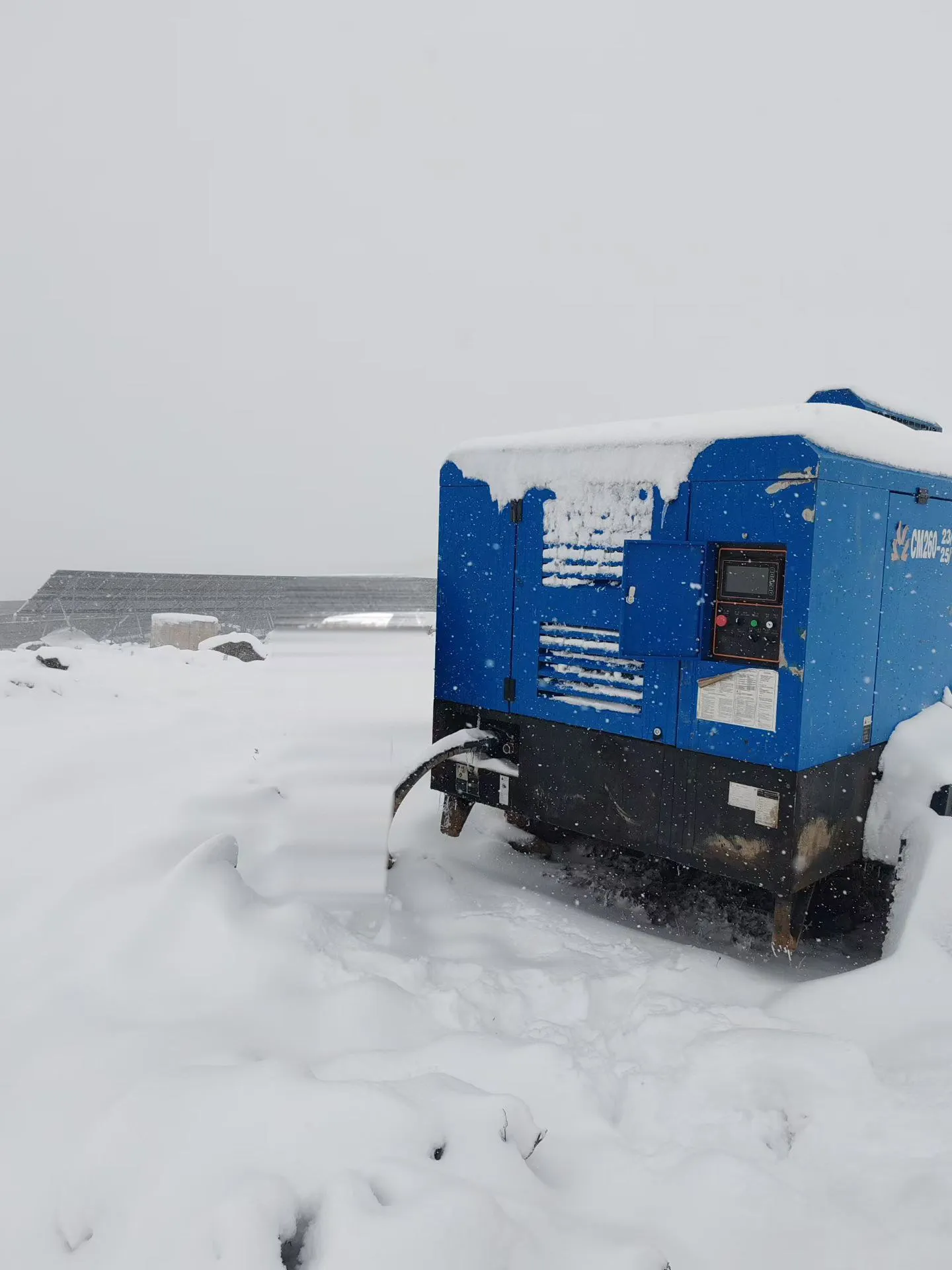
The weakness of electric units is mobility — they need a cable. Scattered water wells, exploration holes, piling that moves between several positions a day, or short jobs where running power isn’t worthwhile are still better served by a diesel unit you can simply tow in.
KayDrill diesel models come standard with Cummins or Yuchai power, and many are dual-duty, switching between high pressure and high flow — ideal for field work where conditions change.
In short
Electric or diesel comes down to doing the sums for your site. With stable power, fixed positions and long running hours, electric is almost always cheaper; without power or with frequent moves, diesel is more flexible. If your site has both situations, combine them. If in doubt, tell our engineers about your site and we’ll work it out with you.

Not sure which model?
Six questions to the right model for your site
Help me choose ›FAQ
Can electric compressors be used at high altitude?
+
Yes. Motors don't lose power from lack of oxygen the way diesel engines do, but thin air cools motors and controls less effectively, so check the cooling and insulation class when selecting.
Do electric and diesel units cover the same pressures?
+
Mostly. KayDrill DM electric units go up to 25 bar and 35 m³/min; for deep holes needing 30–35 bar, choose a diesel model.