How to choose a portable air compressor: work out pressure and air flow first
KayDrill engineering team ·
Choosing a compressor comes down to two numbers: pressure and air flow. Here is how to calculate both, when to choose single- or two-stage, how much margin to leave — with a complete water-well example.
On a drill site, a badly chosen compressor rarely fails straight away. The problems creep in: the hole gets slower, bits wear faster than expected, cuttings stop coming up once you hit water, and eventually the string jams. Often the rig and hammer are fine — the problem is the compressor feeding them.
Choosing a portable compressor really means getting two numbers right: pressure and air flow. Pressure decides whether the hammer works and whether cuttings are lifted from the bottom; air flow decides drilling speed and how cleanly the hole is flushed. This article walks through both for drilling work, so you can estimate a range yourself and check it with your supplier.
Pressure is not one number — it is four added together
People often ask “how many bar do I need for this hole?” as if the rig alone decides. In fact the pressure the compressor must deliver is the sum of four parts.
The first is the hammer’s working pressure. Standard high-pressure hammers run at about 1.7–1.8 MPa and ultra-high-pressure hammers at 2.0–2.4 MPa. That is the floor — below it the hammer won’t hit properly.
The second comes from depth. The deeper the hole, the further the air travels through the rods and the greater the friction loss and back-pressure at the bottom.
The third is water — the one most often underestimated. Below the water table, the column of water in the hole creates back-pressure: about 0.1 MPa, or 1 bar, for every 10 m. Drilling 40 m below the water table adds 4 bar on its own. That is the main reason deep water wells and geothermal wells use 25 bar, 30 bar or more.
The fourth is hose loss. The longer the line from compressor to rig and the more fittings, the bigger the loss.
Add the four together and you have the pressure the compressor really needs. One common misconception deserves a mention: a bigger hammer does not mean more pressure. From 3.5” to 14”, common hammers work at similar pressures — what changes with size is air consumption.
Air flow: check both requirements and take the larger
Air flow has to meet two requirements: the hammer’s own consumption, and the air needed to blow cuttings up from the bottom. Take whichever is larger.
Hammer consumption is in the hammer maker’s data and varies enormously — about 7.5–9 m³/min for a 3.5” hammer and 68–80 m³/min for a 14”.
Flushing air depends on up-hole velocity — how fast the air travels up between the rods and the hole wall. Keep it roughly between 900 and 2,100 m/min. Below that, cuttings are not lifted, get re-crushed at the bottom, slow the bit and can jam it; above it, rods and hole wall wear much faster.
Velocity also depends on rod size. Thicker rods leave less space, so the same air flow gives a higher velocity. If your check shows too high a velocity, the usual fix is a different rod size, not a smaller compressor. With casing advance the annulus is smaller and the casing has to be driven, so add 10–15% to the air flow and go one step up in pressure.
Single- or two-stage depends on pressure
Once you know the pressure, the compression type largely follows. Up to 13 bar, a single-stage unit is simpler and cheaper; from 20 bar a single stage can’t get there, so it must be two-stage.
Between 14 and 19 bar you can use either. Single-stage costs less to buy; two-stage uses less fuel or power at the same pressure. For long continuous duty, the fuel saved over a few years usually exceeds the price difference, so we recommend two-stage.
How much margin? Don’t treat “buy bigger” as insurance
Some margin is necessary, but bigger is not better. A unit far larger than needed runs at low load most of the time, so fuel use and wear per cubic metre go up — expensive to buy and expensive to run.
A sensible approach is 10–15% on top of the calculated figure, then apply the correction factors for altitude or heat, because thin or hot air reduces real output. Holes over 10” or deeper than 200 m usually need several units in parallel — ask an engineer to work those out.
A complete example: a water well that hits water
Say a water well uses a standard high-pressure hammer at 1.7 MPa and will be drilled 40 m below the water table.
Pressure first: 1.7 MPa for the hammer, plus 0.4 MPa for the 40 m water column, plus about 0.1–0.2 MPa for depth and hoses — about 2.2–2.3 MPa in total, so choose a 25 bar unit.
Then air flow: look up the hammer’s rated consumption, check flushing air for the hole and rod size, take the larger, and add 10–15%.
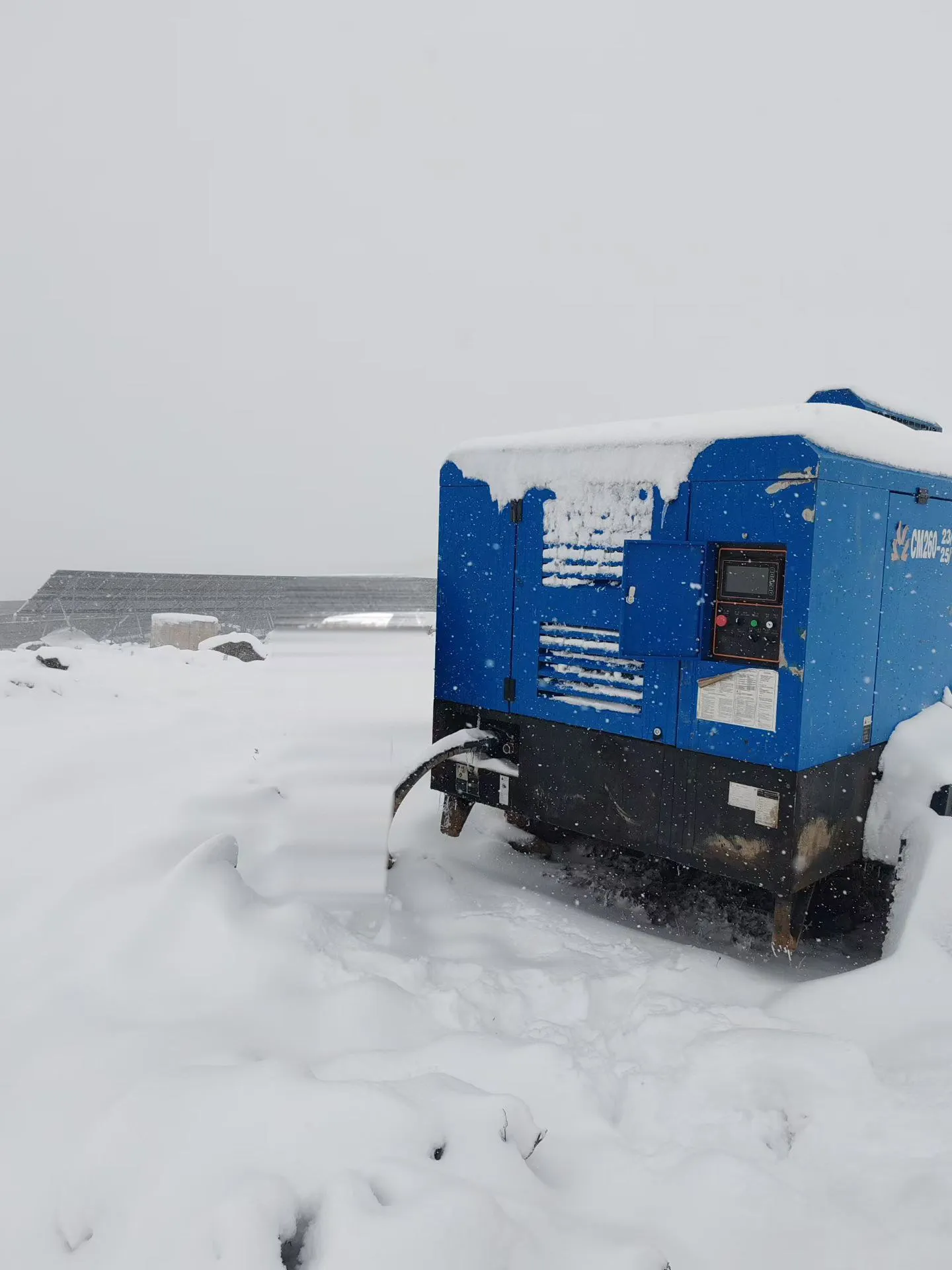
Finally the model. With stable power on site, the KayDrill DM250-31/25 electric unit delivers 31 m³/min at 25 bar. Without power, or if the rig moves often, choose the CM400-31/25-33/18 diesel unit. It is dual-duty: the 25 bar setting for the deep wet section, and one switch to 33 m³/min at 18 bar for shallow drilling and development — one machine for the whole well.
In short
Compressor data sheets look complicated, but it comes down to two things: enough pressure to overcome the hammer, depth and water, and enough air to drive the hammer and clean the hole. Get those two numbers right, choose single- or two-stage by pressure and leave a sensible margin, and you avoid most selection mistakes.
If you’d rather not calculate, use the selection wizard on our website: answer six questions on region, application, hole size and depth, rock and water, site conditions and preferences, and get recommended models. For high altitude, deep holes, casing or several units in parallel, talk to our engineers for a site-specific calculation.

Not sure which model?
Six questions to the right model for your site
Help me choose ›FAQ
Can I choose a compressor from the drill rig model alone?
+
No. You also need the hammer size, hole depth and whether there is water. The same rig drilling a dry hole and a deep wet well can need twice the pressure.
What do the two sets of figures in a model number mean?
+
It is a dual-duty unit. CM400-31/25-33/18, for example, switches between 31 m³/min at 25 bar and 33 m³/min at 18 bar.